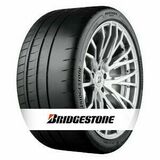
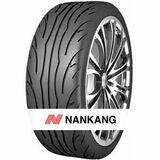
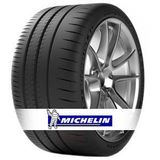
What is a semi-slick tyre?
The semi-slick tyre sits halfway between a standard road tyre and a competition "slick" (smooth). Its design is based on an ultra-rigid casing that prevents sidewall deformation under heavy load, ensuring razor-sharp steering precision.
Unlike a conventional tyre, its tread pattern is reduced to maximise the contact patch. Its compound chemistry is designed to reach peak grip as it comes up to temperature, ideally between 80°C and 100°C.
Why choose a semi-slick pattern?
Switching to semi-slick tyres dramatically transforms your vehicle’s handling:
- Extreme dry grip: A soft compound that grips the tarmac once up to temperature.
- Cornering stability: Large shoulder blocks that don’t collapse under load.
- Thermal endurance: Unlike standard road tyres that overheat and lose grip after 2–3 laps, semi-slick tyres maintain consistent performance over multiple laps.
How to choose your semi-slick tyres?
To select the right model for your needs, we recommend checking these three criteria:
- Weather factor (Water evacuation capacity): Although road-legal, some patterns are more versatile than others. If you often drive in the rain to reach the circuit or for daily use, choose a tyre with pronounced circumferential grooves.
- Road / Track ratio: If you cover long periods of road driving, opt for Medium or Hard compounds to preserve tread life. If your car arrives on a trailer, Soft compounds deliver immediate grip.
- Session duration: For short stints, a soft compound is ideal. For endurance or intensive track use, a harder compound will prevent premature degradation.
Compound hardness and Treadwear index
To navigate the different compound hardness levels, there is an indicator marked on the tyre sidewall called Treadwear.
| Compound Type |
Treadwear |
Use |
| Soft |
40 - 100 |
Pure performance |
| Medium |
100 - 140 |
Ideal compromise for regular track days |
| Hard |
180 - 200 |
Endurance / Leisure |
Please note: Treadwear is a comparative baseline. For some models, also refer to the manufacturer’s specific code (S, M, H) as ratings may vary.
Is a semi-slick tyre road-legal?
Yes, provided it bears the "E" marking (European approval). This marking certifies that the tyre meets the minimum groove ratio required for water evacuation. If a tyre is not approved for the road, it will be indicated on our site by the NHS (Not for Highway Service) specification.
Safety warning: Although approved, semi-slick tyres perform significantly worse in the rain than a road tyre. On waterlogged roads, the risk of aquaplaning is high and demands caution and reduced speed.
Can you drive every day on semi-slicks?
Yes, as long as they are approved with the "E" marking. This is one of the biggest advantages of this tyre: you can drive on the road and enjoy track days.
Although legal, our experts do not recommend them for everyday road use. Semi-slick tyres wear faster and are less suitable in the wet. Keep them for your weekend outings or your track days.
What pressure should you use in semi-slick tyres on track?
The goal is to reach the target hot pressure after a few laps. As air expands with heat, pressure can increase by 0.4 to 0.7 bar during a session.
Here is a reference table to adjust your starting pressures according to ambient temperature.
| Condition / Temperature |
COLD pressure (Start) |
HOT pressure (Target) |
| Cold weather (< 10°C) |
1.9 – 2.1 bar |
2.1 – 2.5 bar |
| Mild weather (10 – 25°C) |
1.7 – 1.9 bar |
2.1 – 2.5 bar |
| Hot weather (> 25°C) |
1.5 – 1.7 bar |
2.1 – 2.5 bar |
| Wet track / Rain |
Road baseline + 0.2 bar |
Road baseline + 0.4 bar |
Note: These values are indicative. Always refer to the manufacturer’s specific recommendations (e.g. Michelin recommends 2.3 bar hot for the Cup 2).
Safety: Never go below a minimum pressure of 1.3 bar cold.
GRIP500 tip to maximise the lifespan of your semi-slick tyres.
- Respect warm-up: Do not stress the tyre when cold to avoid early compound wear.
- Precise alignment: Appropriate camber prevents premature wear of the outer shoulders.
- Optimal storage: Keep your tyres protected from frost and UV to prevent the compound from cracking.